I’ve been meaning to write about this for quite some time – and it seems to be ramping up.
I’ve done some searching online and copy/pasted JUST ONE of the “Senders'” email names – I found this search result to be very clear:
An AI Overview:
Based on current reports, there is a surge of sophisticated, AI-supported phishing scams targeting indie authors, often using generic Gmail addresses to initiate contact. While specific email addresses change frequently, scammers often adopt fake names or impersonate industry professionals to offer fake “marketing opportunities,” “book club features,” or “literary agent” representation.
If you have received an email from beccawoodwXXXX@gmail.com, it is highly likely part of this ongoing, widespread scam campaign.
This certainly was exactly the type of email I received. The search result went on with the following details:
Key Red Flags of This Scam
- Use of Free Email Services: Legitimate publishers, editors, and established marketers do not conduct business from generic @gmail.com or @outlook.com addresses.
- Overly Flattering & Vague Content: The emails often use intense flattery to get you to lower your guard, sometimes without mentioning the actual title of your book, or using AI to generate general praise that doesn’t match the story.
- Upfront Fees: Scammers often claim they want to promote your book but demand a “reservation fee,” “service fee,” or “marketing package” payment to start.
- High-Pressure Tactics: They may create a false sense of urgency, urging you to sign a contract or pay immediately to take advantage of an “opportunity”.
And now here are the concise ACTIONS we can take as Authors:
What To Do About Author Email Scams
- Do Not Reply: Replying signals that your email address is active, which will lead to more scam attempts.
- Delete and Block: Block the sender in your email client.
- Report the Scam: Report the email as phishing to Gmail.
- Do Not Pay: Never pay for services to be “featured” in ways that sound too good to be true, such as guaranteed high-profile media coverage from an unsolicited email.
- Research: Search the name or email address in author forums or on sites like “Writer Beware” to see if others have reported it.
The final piece of advice at the end of this search result:
The safest course of action is to delete the email, because legitimate, professional opportunities rarely come via cold-email from a personal, unknown Gmail account.
I get a couple of these types of emails each day – mostly cookie-cutter/exactly the same, apart from the email/gmail name, and also using different email names of mine.
It’s never-ending, non-stop, and we should NOT SPEND ANY TIME trying to stop or solve this. But don’t worry – it’s not too late to feel back in control:
The safest course of action is to delete the email (after reporting it).
My suggestion today is to focus on what matters most – writing, creating and publishing your books, continue to be a wonderful, proud author, get your name out there and bask in the glow of wonderful connections with potential readers and other authors.
What you can do about Email Scams Targetting Authors
PS – I use Gmail and when I see these scam emails, I click the checkbox next to them (on the left of the email), and cthen lick on the SPAM button above the email in Gmail as follows:
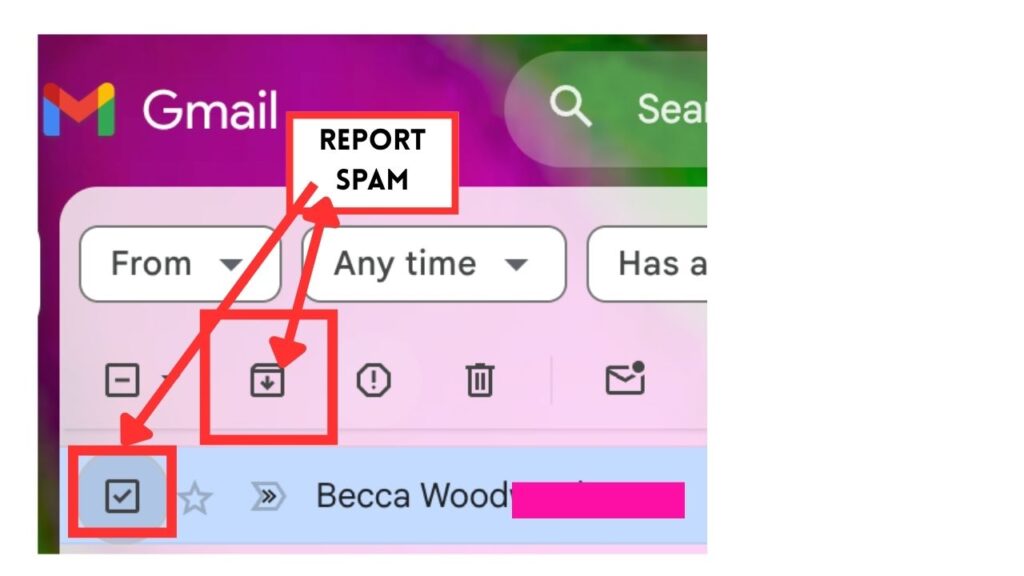
“Out damn SPAM, out I say!” (Old Shakespearian phrase sprang to mind!)
Have a spectacular day! And if you have any questions, please do reach out and let me know 🙂
Hugs
Teena!
Teena Hughes